
Seiko Vintage Watch - The Turtle 6306-7001: The Beast from Japan
Joshua GrilletThe story of Seiko's legendary vintage diving watch, the Turtle Diver 6306-7001
In the world of vintage Seiko diving watches, some are legendary and become as desirable as they are difficult to find for “Seikoholics.”
The Turtle 6306 clearly falls into this category.
Between 1965 and 1975, Seiko brilliantly designed and produced three generations of ISO 150m certified dive watches. In chronological order, these were the 62MAS, the 6105-8000/9, and the 6105-8010/9. In 1975, Seiko tasked a young engineer named Ikuo Tokunaga with creating the new Diver 150m.

In 1976, Seiko released the replacement for the 6105, designed in two versions. One was for the Japanese market and the other for foreign markets. The latter international variant, the 6309, was equipped with a 17-jewel 6309A automatic movement and a bilingual day display adapted to the target geographical area, while the version reserved for the Japanese market (JDM), the 6306, was equipped with a more advanced movement, the 6306A with 21 jewels, a stop-second system, and a day display in English/Japanese kanji.
The Japanese versions of Seiko models often have more advanced movements than the export versions, as in the Pogue, for example, with 21 jewels in the JDM version compared to 17 in the export version. Was this due to customs taxation issues or simply a gesture of goodwill towards its long-standing customers?
The 6306 had a fairly short lifespan, as it was only produced from 1976 to 1981. Seiko kept the 6309 in its catalog until it was replaced by the Diver 7002 in 1988.
Both versions were popular with the US military, like its predecessor the 6105 (which was much more expensive), and quickly became essential tools.

Analysis of the legendary vintage Seiko Turtle Diver 6306-7001 diving watch
Here is the gem I found, a 6306-7001 from January 1969 in fairly good cosmetic condition. At first glance, the glass and bezel have a few scratches and the movement is running poorly. In addition, there is a little play in the bezel.


Seiko 6306 overhaul: disassembly and cleaning
Let's proceed with disassembling the movement.
It is very dirty, and the oils have completely worn away. A good overhaul won't do it any harm. Perhaps this is its first overhaul?


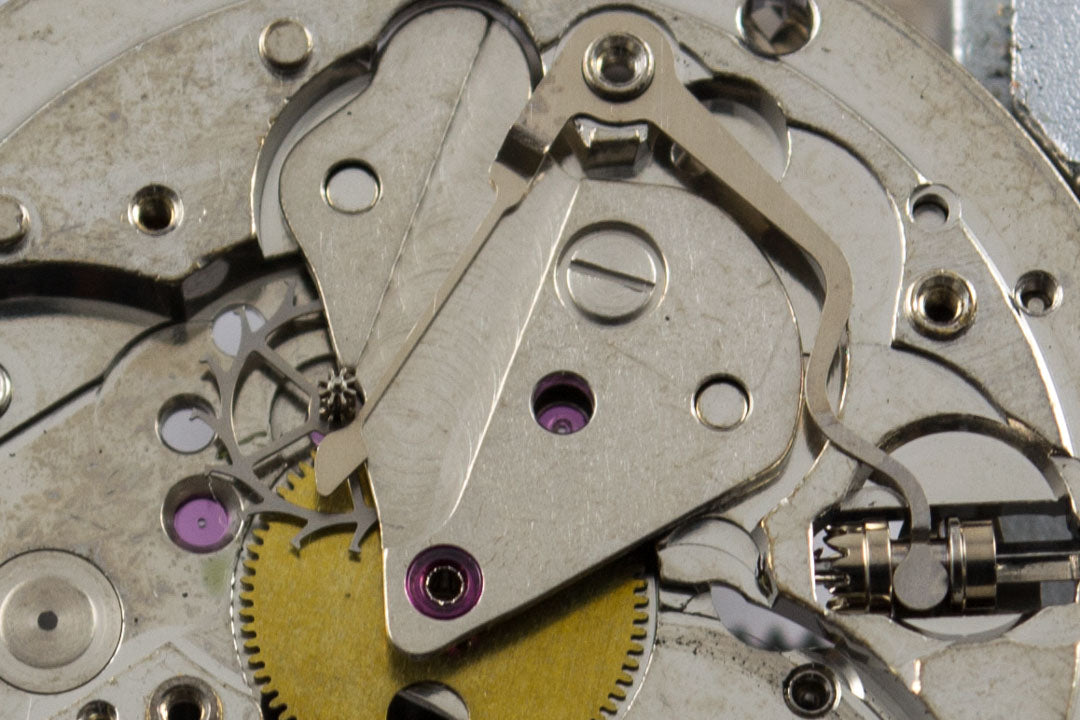
Here you can see its stop-second system. A lever connected to the winding stem touches the escapement wheel's axle when the watch is being set to the correct time. This stops the movement, and the second hand remains stationary for more accurate time setting.



Seiko 6306 overhaul: reassembly and oiling


The movement has been reassembled without its automatic system. It will be replaced just before closing the watch case back to allow better access to the balance wheel settings.
Seiko Turtle Diver 6306-7001: replacing the crystal
A new crystal is placed on the “L” seal and held in place by a clipped-on bezel.

The bezel can be replaced with a new gasket, which eliminates any play. The dial/hands/movement assembly is placed in the case, along with the winding stem and automatic system. A new case back gasket is installed, the screw-down case back can be closed, and you can once again enjoy a precise watch!


Seiko Turtle Diver 6306-7001 : Conclusion


This diver's watch is iconic, and Seiko understands this well, reissuing it in countless versions.
Its place in the history of Seiko, diving, and the military make it a must-have for collectors. I admit to jealously guarding one in my collection.
To dress it up nicely, you can equip it with a NATO strap, a vintage Tropic strap, or a reproduction. Ideally, you would find its original GL831, but these straps have aged poorly and few have survived. These straps have been reissued by Seiko and Uncle Seiko.


This article is part of an ongoing exploration of vintage watches.
I offer independent analysis and private inspections for collectors.
Have a great time on the website!
Joshua Grillet